HoloBox for Schools
Build real optics experiments, see light behave like a wave, and record your own digital holograms — no expensive lab required.
The HoloBox is a box of openUC2 cubes plus a small "smart camera" in the form of a Raspberry Pi 5 + Camera Module v2.1. With it you can build the same kinds of experiments that won Nobel Prizes: (Yay!)
- Michelson interferometer
- Mach–Zehnder interferometer
- lensless holographic microscope (Well Gabor won it for Holography, but still! :)
... and then reconstruct the holograms on a computer.
These pages are written for high-school students and their teachers. You don't need university maths. The only thing you need: curiosity!
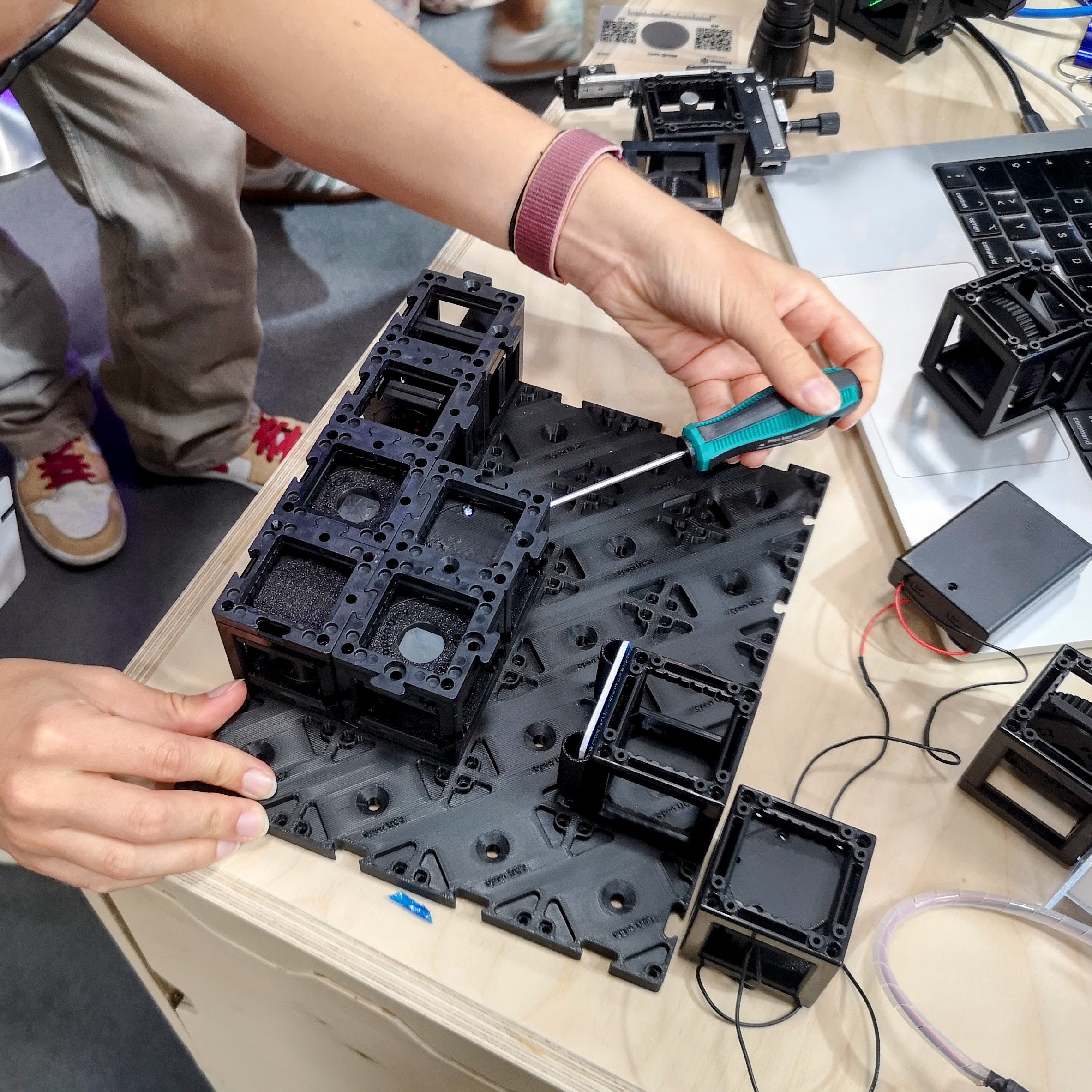 Show: As part of the holobox you can build a Mach Zehnder Interferometer, where the camera acquires fringes.
Universität Münster
Mathematisch-Naturwissenschaftliche Fakultät
Institut der Didaktik für Physik
Masterarbeit zum Thema:
Entwicklung von Unterrichtsmaterialien für
Experimente zur digitalen Inline-Holografie.
Development of Teaching Materials for Experiments in Digital Inline Holography.
Vorgelegt von:
Clara Hofmann
Hermannstraße 41, 48151 Münster
clara.hofmann@uni-muenster.de
Where do I start?
This documentation is following Diataxis (https://diataxis.fr/) and is split into four kinds of page. Pick the one that matches what you want right now:
I want to build something today => Tutorials
Step-by-step, can't-fail walkthroughs. Start here if you have the box in front of you.
- Your first interference pattern (Michelson) — the friendliest first success. ~30 min.
- Your first hologram (inline holography) — record a hologram and bring a hidden image into focus on the computer. ~45 min.
I know the basics and have a specific goal => How-to guides
Short, practical recipes for one task each.
I want to understand why it works => Explanation
Read these on the sofa. No equipment needed.
- Light as a wave
- Interference and diffraction
- What is a hologram? — the one idea most people get wrong.
- How the computer reconstruction works
I just need a number or a definition => Reference
- Parts and parameters
- Glossary (English + German terms)
A suggested classroom journey
If you're a teacher planning a unit, this order matches the physics build-up used in the Münster teaching materials:
- Read Light as a wave and Interference and diffraction.
- Build the Michelson interferometer — students see interference with their own eyes.
- Discuss What is a hologram? — connect what they saw to the idea of recording a wave.
- Build the inline holographic microscope and reconstruct a real sample.
- Go deeper with how reconstruction works.
What can you actually observe?
- Bright and dark interference fringes that shift when you nudge a mirror by less than a thousandth of a millimetre.
- A hologram: a pattern of fine rings that looks like nothing — until the computer turns it into a sharp picture of a tiny object.
- Refocusing after the image is taken - something an ordinary camera can never do.
Open source
Everything about the HoloBox is open: the hardware (CAD files), the firmware, the reconstruction software, and these teaching materials. You may copy, remix, and reprint them for your class. See the openUC2 docs home for licences.