How telescopes work
Understanding-oriented. Read after (or instead of) building — the tutorial is the hands-on version.
A telescope does something odd if you think about it: the Moon is no brighter and no closer after you build one. What a telescope really enlarges is the angle under which you see things.
Angles are everything
A distant object sends you practically parallel rays, arriving at some small angle α to the axis. Your eye turns that angle into image size on the retina. A telescope is an angle amplifier: parallel rays in at angle α, parallel rays out at a larger angle β. The magnification is
Both CoreBox telescopes use the 100 mm objective, so with the 50 mm (or −50 mm) eyepiece both give M = 2. The way they do it differs — and that difference decides image orientation, tube length and field of view.
The Galilean telescope: intercept before the focus
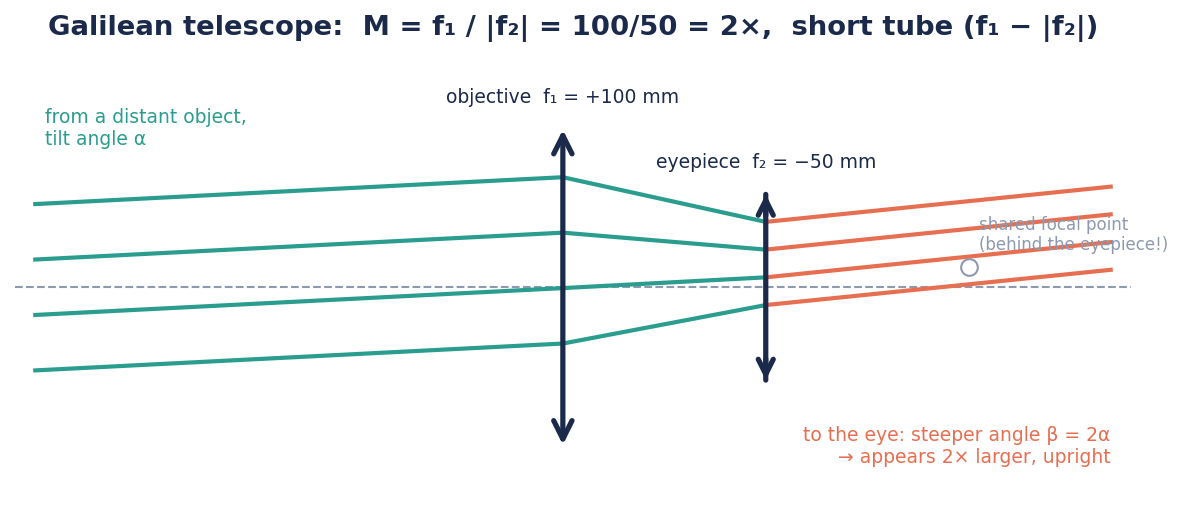
The objective starts bundling the rays towards its focal point — but the diverging eyepiece intercepts them first and straightens them out again. The two focal points coincide behind the eyepiece, so the tube is short: mm.
Because the rays never cross, the image stays upright — which is why opera glasses and cheap binoculars-toys use this design. The price: no real intermediate image exists, the field of view is small, and high magnification is impractical.
The Kepler telescope: go through the focus
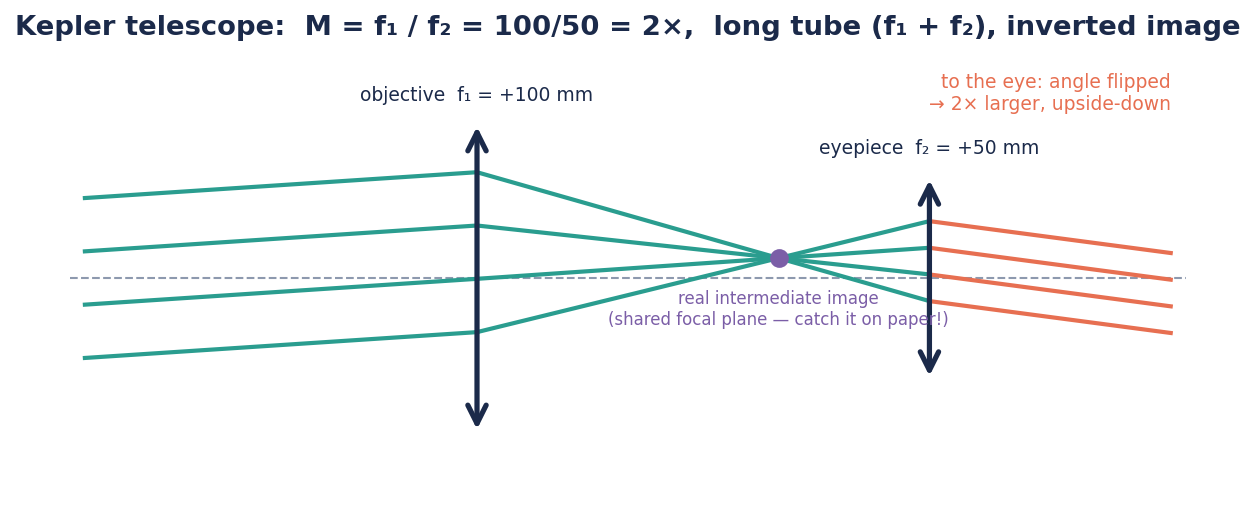
Here the objective is allowed to finish the job: the rays cross in the shared focal plane and form a real intermediate image — tiny, floating in the middle of the tube, upside-down (as every real image is, see previous page). The converging eyepiece then works as a magnifier looking at that image.
Consequences:
- The tube is long: mm.
- The image is inverted — the eyepiece magnifies but doesn't un-flip.
- The intermediate image is a real place: you can put a paper screen there (try it!), or crosshairs — which is why rifle scopes and measuring telescopes are Kepler designs.
- Field of view and achievable magnification beat the Galilean, which is why astronomy uses Kepler — stars don't mind being upside-down.
Side-by-side
| Galilean | Kepler | |
|---|---|---|
| Eyepiece | diverging (−50 mm) | converging (+50 mm) |
| Tube length | = 50 mm | = 150 mm |
| Image | upright | inverted |
| Intermediate image | none | real, accessible |
| Field of view | small | larger |
| Used in | opera glasses | astronomy, scopes |
Making Kepler upright again: the spotting scope
Insert a third converging lens behind the intermediate image at 1:1 () and it re-inverts the image without changing the magnification — the classical terrestrial telescope. It works in the CoreBox but gets long; real binoculars solve the same problem compactly with prisms.
Two questions worth asking in class
- Why not just use a stronger eyepiece for more magnification? Try it: swap the Kepler eyepiece for a shorter focal length. The image grows — and gets darker, dimmer, shakier. Magnification without more collected light is empty.
- What does the objective diameter do? It collects light and sets resolution. That's why observatories build mirrors measured in metres — and why the same idea returns as numerical aperture in the microscope.
Next: How a microscope works →